
To comply with the Paris Agreement, the carbon intensity of agricultural production must decrease by approximately 3% per year through 2030. This is the first step toward achieving carbon neutrality by 2050. However, emissions from the agricultural sector have decreased by only 12% between 1990 and 2022.
A challenge of widespread adoption
For the past decade or so, pioneering food companies have been creating and funding pilot agroecological farms, such as Nestlé’s net-zero emissions farm in South Africa. These initiatives serve as exemplary models, but scaling them up is still proceeding too slowly.
Yet a mid-sized food company processes the equivalent of the output of hundreds of farmers—not to mention the major corporations. It is therefore urgent to focus on scaling up production in order to stay on track with the Paris Agreement’s climate goals.
Reward results rather than effort
Scaling up the agricultural transition requires a significant mobilization of resources, which in turn creates value for those who finance it. However, the food industry currently provides the bulk of the funding for the implementation of on-farm practices—in other words, for the resources themselves.
Wouldn’t it be more effective to highlight the results achieved by farmers, backed up by concrete evidence? The advertised reduction in carbon footprint is a good example of this, a strategy already tested by several food brands in the United Kingdom and the United States.
It may therefore be necessary to shift paradigms and develop a model that enables manufacturers to capitalize on the quantitative results generated by their investments.
In other words, to shift to a funding model based on actual results rather than solely on the practices and resources employed.
Mutual benefits for everyone
Reducing the carbon footprint of agricultural production is the best way to “monetize” the transition. Indeed, this measure is crucial for food manufacturers, who, in exchange for this reduction, will agree to actively contribute to its financing.
Beyond the specific interests of individual sectors, carbon measurement should be viewed more broadly as an indicator of the effectiveness of other soil regeneration measures. And this is primarily for the benefit of farmers.
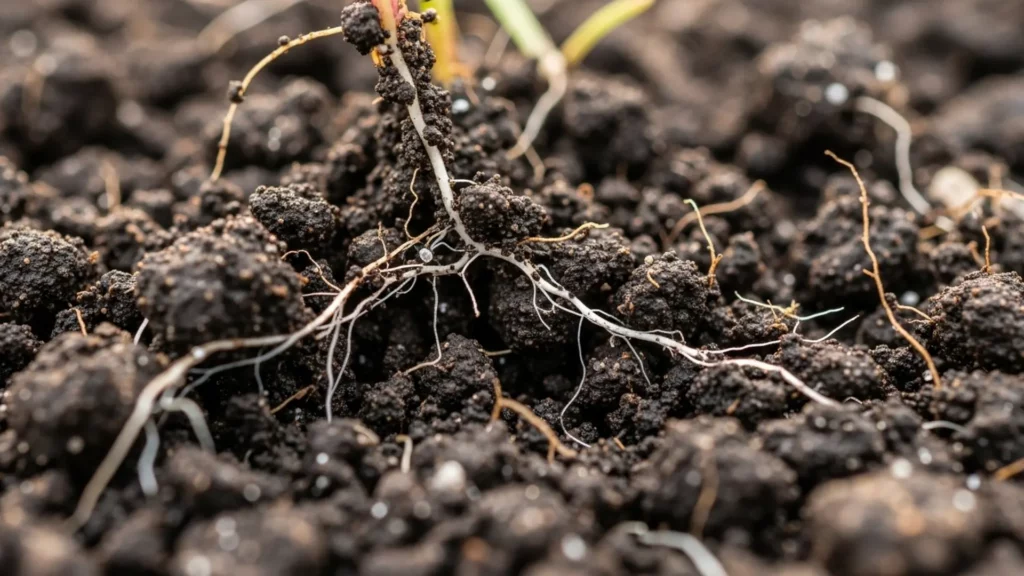
In fact, a higher amount of organic matter in the soil—which is synonymous with carbon—creates conditions conducive to the development of microbial life (bacteria and fungi) as well as fauna (especially earthworms).
All of these organisms are key to restoring soil fertility and thus ensuring future yields that can support the resilience of farms.
Furthermore, combining increased organic matter with reduced tillage (RT) helps curb erosion, maintain biodiversity in fields, and preserve soil moisture. These various benefits contribute not only to farmers’ resilience but also to regional balance and food sovereignty, which has once again become a key issue.
That is why at Carbone Farmers, we focus our efforts on measuring carbon. Carbon is a key indicator—the one that drives all the others.
A financial balance that has yet to be achieved
While quantifying emissions reductions and measuring co-benefits undoubtedly creates value, securing funding for these efforts from downstream sectors remains a delicate matter.
The inflationary environment we have been experiencing since the end of the COVID-19 pandemic—exacerbated by Russia’s invasion of Ukraine—makes any further price increases difficult to justify, even for recognized causes such as the green transition. These concerns, which are entirely legitimate, prevent manufacturers and retailers from embracing the issue and using it as a point of differentiation. Therefore, only a pooling of approaches and co-financing by industry stakeholders can make the financing of the transition acceptable and manageable.
The model proposed by Carbone Farmers takes these constraints into account. We determine how funding is allocated by including carbon credit buyers who are outside the value chain.
Further reading:Why is it important to calculate the cost of the transition?