
Communicating correctly about one's carbon contribution actions is a recommendation of the’ADEME, and even a serious recommendation.
Carbone Farmers is based on its 2022 report, Use of the «carbon neutrality» argument in communications, to give you some keys to communicate about your actions for global carbon neutrality, without falling into the trap of greenwashing.
In particular, this article is aimed at companies wishing to highlight their carbon credit purchases for climate contribution purposes.
Carbon neutrality only makes sense on a global scale.
First of all, let's revisit the concept of carbon neutrality: the sum of greenhouse gas emissions, or GHGs (in CO₂e) minus the sum of CO₂e sequestered must be equal to 0, i.e. CO2e emissions – CO2e sequestered = 0.
Or, according to ADEME, the objective of carbon neutrality, namely the balance between anthropogenic emissions and sequestrations of GHGs, truly only makes sense on a global scale. ⚠️ Therefore, beware of misleading phrasing: a local authority, a company and, more broadly, an economic player cannot be «carbon neutral». This could lead one to believe that the territory, the activity or the product no longer has any impact in terms of greenhouse gases (which is very often false, or even impossible).
In short, the abusive use of the term “carbon neutrality’ suggests that it is possible to effectively combat climate change with only contributions/offsets, without real emission reduction efforts and without changing individual behaviours.
For a company's carbon offsetting action not to be greenwashing
A second term can be confusing: carbon offsetting. This can give the impression that offsetting actions can cancel out emissions released elsewhere, which absolves those who use them of responsibility.
However, ADEME supports the principle of voluntary offsetting, but with the addition of a few principles:
- Communicate responsibly
- To publish one's greenhouse gas emissions, reductions and offsets balance.
- Choose certified offset projects
- Prioritising projects that take into account environmental, social, and economic impacts
- To support projects both domestically and internationally.
What does it mean to responsibly communicate your purchase of carbon credits?
Carbon footprint and offsetting credits, differentiated communication
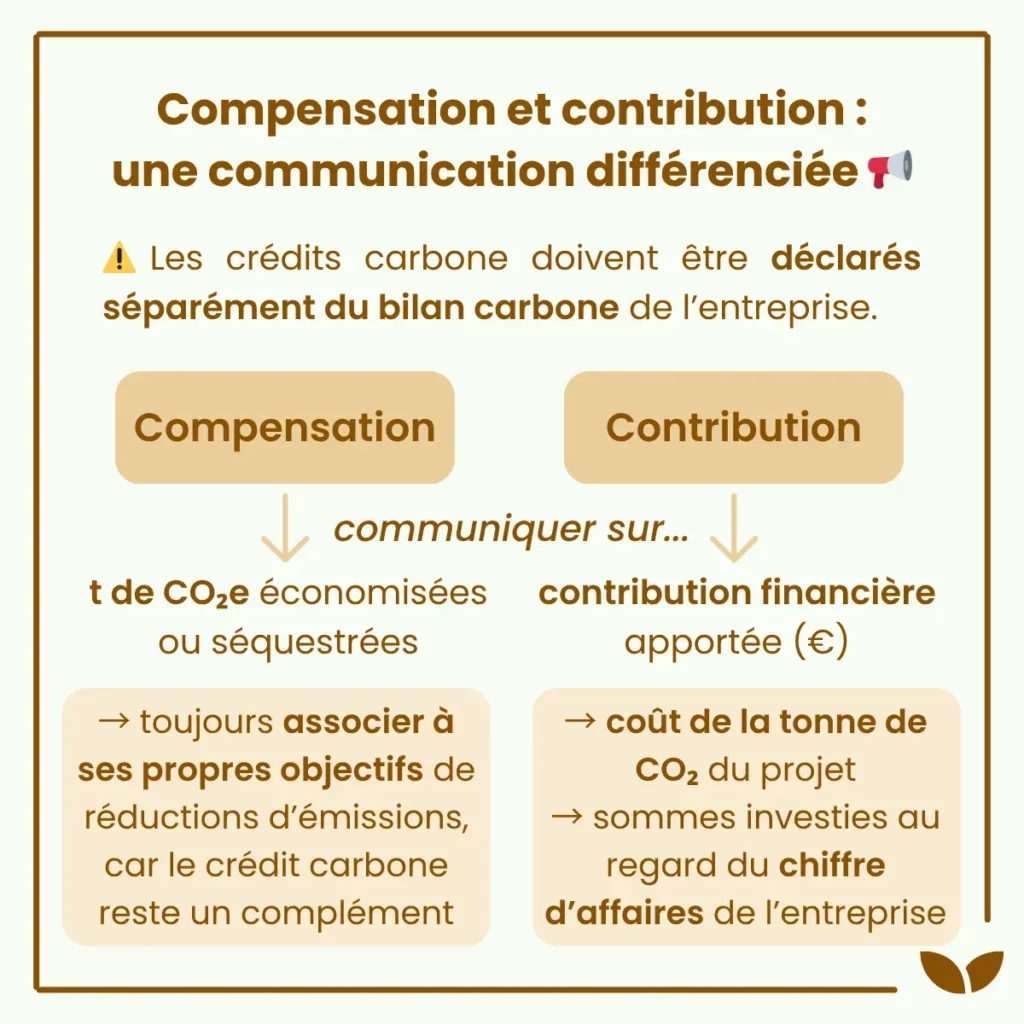
As a reminder, carbon credits purchased by your company must be declared separately from your carbon footprint. Depending on your objectives and therefore the ultimate use of these carbon credits, namely for offsetting or contribution, you must adopt a different communication approach.
The SBTi FLAG and the GHG Protocol, international frameworks that govern carbon accounting, recommend two approaches:
- For contributions : Communication on financial contribution, in €. In this case, it is not necessary to avoid double counting.
- For compensation communication on the tonne of CO2e saved or sequestered. In this case, carbon credits must quantify a unique reduction or sequestration. They should only be accounted for once.
Good general practices for communicating about your climate commitment
Several good communication practices are highlighted by ADEME. They concern all types of projects supported for climate change mitigation purposes:
1️⃣ Firstly, the focus should be on building a narrative around the history of the projects supported, rather than on the company's financing and the amount of CO₂ avoided/sequestered. Communication should be project-centred, not on the company funding it.
2️⃣ Next, allegations must be supported by credible evidence that aids understanding:
- Calculation methodologies
- Greenhouse gas emissions results
- Company reduction strategy
- Information on funded sequestration projects
- Potential labelling and framework
3️⃣ Finally, care must be taken to ban shortcuts like “zero-carbon territory/company”, “carbon-neutral product”, “net-zero carbon footprint” in favour of more precise, evidence-backed terms. And to prefer formulations like: “Company committed to global carbon neutrality / on a path to carbon neutrality”.
Best practices for carbon offsetting and some examples of successful communication.
When it comes to offsetting credits, try to always pair the announcement of the offset with communication about reduction efforts made within your value chain, to strongly emphasise that carbon credits remain a supplement.
Here are some examples of responsible communication:
- “Thanks to these efforts, we have reduced our GHG emissions by X% over X years. To take our commitment to the environment a step further, we have decided to support regenerative agriculture by backing agricultural carbon sinks certified under the Low Carbon Label scheme, representing X tonnes of CO₂e sequestered.”
- “As well as reducing our own GHG emissions by X% this year, we have funded a project that has helped sequester X tonnes of CO₂e [link to project description, etc.].”
Best practices for carbon contributions and some examples of successful communication
For ADEME, as part of the contribution, it is preferable to communicate on the sums invested, both:
- the cost per tonne of CO₂ for the project
- the amounts invested compared with the organisation’s turnover (e.g. 1%–3% of turnover)
When it comes to pure contribution, it is necessary that your company uses wording that does not suggest it is compensation: “financed reductions or sequestration”, “financed GHG mitigation”, etc. Here are some good examples of wording:
- “This year, our company funded X GHG sequestration and emission reduction projects, which have obtained the Carbon Label, in [specify regions], representing a total of €X.”
- “For X years, we have financially supported, to the tune of €X/year, (if relevant) the [name] project, awarded the [label] label, which contributes to the resilience of [region] in the face of climate change.”
- “We have purchased X carbon credits to support certified projects and thereby contribute to the global neutrality objective.”
Best practices for describing climate targets and valuing GHG emissions reduction efforts
- At company level: “Our company is committed to reducing its direct emissions by X % by 2030 and by Y % by 2035 (compared to year n…). These reduction targets are science-based and consistent with the global goal of limiting global warming to +1.5°C.”
- At product level: “The carbon footprint associated with the design and manufacture of our product has been reduced by X% over the past X years. Find out more: www…”
Carbone Farmers recommends that companies wishing to highlight their climate commitment:
Carbone Farmers certifies and sells carbon credits generated from certified French agricultural projects. Label bas carbone certification..
All Our credits are plotted and give you access to a number of useful pieces of information for your communication : geographical area, location of farms, tonnes of CO₂e saved or sequestered, number of farms in transition, area of agricultural land regenerated, technical and economic orientations of the farms concerned, main levers implemented, etc. On-site visits are also possible, to meet the farmers being supported.
In short, the key takeaways from this article for your communication are the following points. The main difference between offset credits and contribution credits lies in their usage, and therefore, in how you communicate them:
- Offsetting credit Communicate on the tonnes of CO₂e saved or sequestered. Link the purchase of offsetting credits to your own emission reduction targets. Do not forget that carbon credits remain a supplement.
- Contribution credit Communicate the financial contribution made to a particular climate mitigation project, i.e. the amount of carbon credits purchased. This can be:
- Cost per tonne of CO₂ for the project
- We are invested in relation to the company's turnover.
If you wish to support agricultural transition projects and learn how to communicate your commitment without the risk of greenwashing, speak with our carbon and climate experts!