
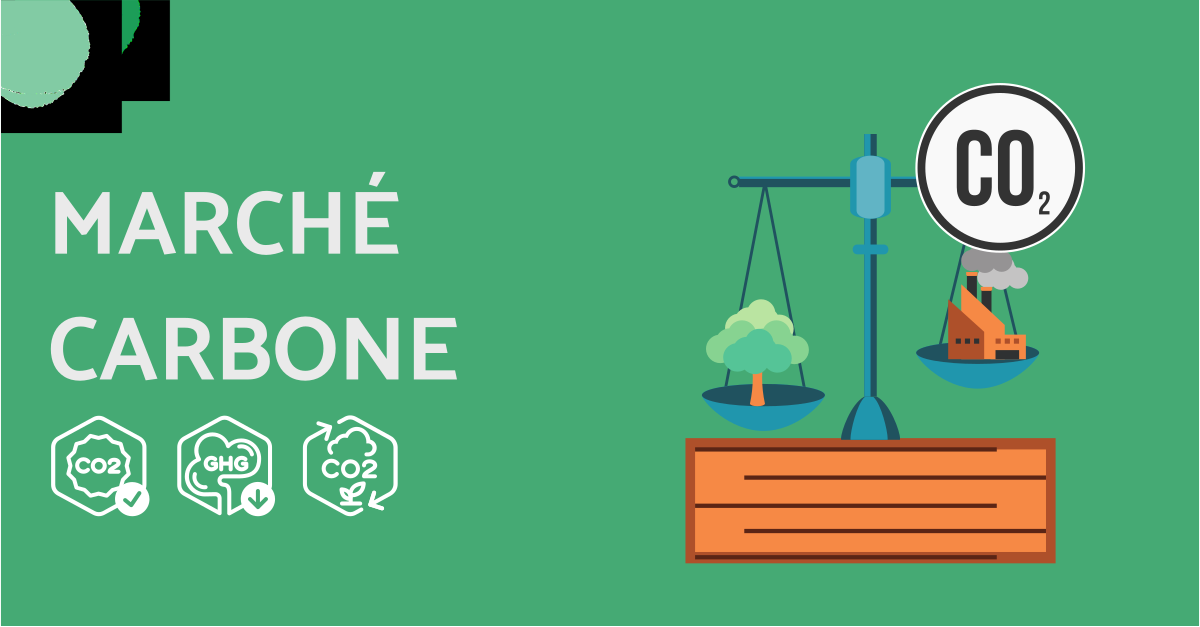
Over the past few decades, the issue of climate change has emerged as one of the most pressing and critical challenges of our time. Environmental degradation, rising global temperatures, and extreme weather events have made individuals, businesses, and governments increasingly aware of the urgent need to take action to reduce greenhouse gas (GHG) emissions.
It is in this context that the voluntary carbon credit market emerged, offering everyone an opportunity to actively contribute to the fight against climate change.
The voluntary carbon credit market context
The voluntary carbon credit market emerged in the 1990s in response to the Kyoto Protocol, an international agreement aimed at reducing GHG emissions. Although it established binding targets for developed countries, it did not include specific obligations for developing countries. This therefore created an opportunity for businesses and individuals keen to voluntarily get involved in reducing carbon emissions.
The establishment of the voluntary carbon market mechanism
The voluntary carbon credit market is based on a relatively simple but effective mechanism. Organisations, companies, or individuals can choose to finance projects around the world by purchasing carbon credits.
1 carbon credit 1 tonne of CO2eq avoided
These carbon credits are generated by clean development projects in sectors such as renewable energy, reforestation, energy efficiency, and many others. Each project undergoes rigorous verification to ensure it effectively contributes to emission reductions. Once verified, carbon credits can be purchased and used to offset an organisation's or an individual's own carbon emissions.
Types of carbon credits
There are generally 4 types of carbon credits:
- the emission reduction ;
- the Nature conservation (including combating deforestation); ;
- the nature-based sequestration, like reforestation; ;
- technological elimination of CO2 from the atmosphere.
Prevention or reduction of emissions
This category concerns projects targeting greenhouse gas emissions other than CO2.
The Existing GES :
carbon dioxide, CO2 methane, Methane Nitrous oxide, N₂O ozone, O3 | water vapour
Methane, for example, is a very potent greenhouse gas. It is emitted in large quantities by landfills and waste management facilities. Projects aimed at preventing or reducing methane emissions contribute significantly to the fight against climate change.
2. Nature conservation
This category of carbon credits concerns projects and initiatives aimed at preserving existing natural ecosystems. Forests, mangroves, peatlands, and wetlands, for example.
Deforestation is one of the main sources of CO2 emissions, as the destruction of forests releases the carbon stored in trees and soil. Nature conservation projects help to avoid these emissions by protecting natural habitats and by preventing the destruction of ecosystems essential for carbon capture.
3. Nature-based sequestration
This category is related to projects that encourage the growth of new trees and the restoration of degraded ecosystems.
Trees, by capturing CO2 from the atmosphere during photosynthesis, play a crucial role in carbon sequestration. Reforestation aims to increase forest cover, which helps to reduce atmospheric CO2 levels, while also providing additional benefits such as biodiversity, local climate regulation, and soil protection.
4. Technological CO2 Removal from the Atmosphere
This category of carbon credits concerns emerging technologies that have the capacity to directly remove CO2 from the atmosphere.
For example, carbon capture and storage (CCS) technologies make it possible to capture CO2 emitted by large industrial facilities and to store it permanently underground. These technologies offer a complementary way to reduce CO2 levels in the atmosphere and could eventually play a role in the transition to a decarbonised economy once their effectiveness has been proven.
This excellent Arte documentary on scientific experiments for CO2 capture: Can we cool the planet?
By supporting projects in these four categories, carbon credits help to «offset» the emissions of companies and individuals, while also fostering the development of sustainable solutions to combat climate change. This allows voluntary market players to actively contribute to environmental preservation for a more climate-friendly future.
What potential impact on the environment of these carbon credits?
In its latest study A blueprint for scaling voluntary carbon markets to meet the climate challenge, McKinsey estimated the potential supply of each category by 2030 for a total of 8 to 12 GtCO2e.
This estimate is a «practical» estimate. It does not take into account the challenges of mobilising these carbon sinks, which, once taken into account, fall to a total of 1 to 5 GtCO2e.
Potential for carbon credit generation by 2030, in gigatonnes.
The benefits of the voluntary carbon credit market
The voluntary carbon credit market offers many significant advantages in the fight against climate change:
The voluntary carbon credit market has become a powerful tool for tackling climate change.
Its emergence in the 1990s marked an important step in raising awareness of the need to take action to reduce greenhouse gas emissions. Companies and individuals can now play a vital role by financing emission reduction projects and actively participating in the transition to a more sustainable economy.
However, It is important to note that the voluntary carbon credit market should not be viewed as a one-size-fits-all solution., but rather as a supplement to government policies and collective actions in addressing the global climate challenge.
Sources
- UNFCCC (United Nations Framework Convention on Climate Change) https://unfccc.int/
- The Carbon Market Institute – https://carbonmarketinstitute.org/
- Environmental Finance – https://www.environmental-finance.com/
- World Resources Institute https://www.wri.org/
- Ecosystem Marketplace – https://www.ecosystemmarketplace.com/
- McKinsey – https://www.mckinsey.com/capabilities/sustainability/our-insights/a-blueprint-for-scaling-voluntary-carbon-markets-to-meet-the-climate-challenge#/
- 3Degrees – https://3degreesinc.com/services/carbon-credits/