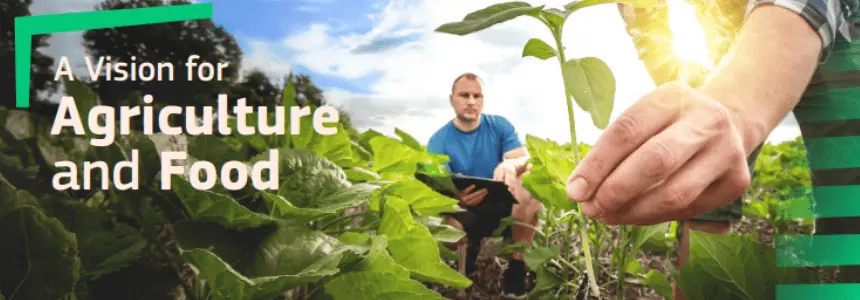
Between structural difficulties and crisis management linked to Lumpy Skin Disease (LSD), the French agricultural world finds itself once again on the brink of disaster. Among its concerns, the CAP reform coming soon in the new Multiannual Financial Framework (2028-2034). This revision should be placed in the context of the « Vision for agriculture and food » of the Commission, successor to the strategy « farm to fork »(F2F – «Farm to fork» in French).
This is an opportunity to review and assess recent developments in European agricultural policy within the framework of the Green Deal.
The Green Deal, or European Green Pact, what is it?
A set of measures to combat climate change
Ecological issues took centre stage in the 2019 European elections, which saw Ursula von der Leyen take charge of the European Commission, whose stated priority was the fight against climate change. However, the geopolitical context has reoriented the priorities of the second von der Leyen Commission towards issues of competitiveness and defence.
A full signatory to the United Nations Framework Convention on Climate Change (UNFCCC – 1994) and the Kyoto Protocol (1997), the EU is putting its commitment to respecting the IPCC's recommendations into practice (limiting global warming to 2°C – 1.5°C if possible – by 2100), enshrined in the Paris Agreement (COP21 – 2015), by adopting the European Green Deal (or Green Deal).
The plan aims to achieve carbon neutrality by 2050 (meaning that any remaining greenhouse gas emissions will be offset by carbon sinks and industrial processes), with an interim target of -55% by 2030 (Fit for 55). In 2025, the EU added two interim targets: a reduction of between 66.25% and 72.5% by 2035, and 90% by 2040.
In a nutshell, The Green Deal is the EU's roadmap for tackling climate change, and consequently impacts all its business sectors.
The farm to fork strategy, the application of the Green Deal to the agricultural sector
The agricultural and food sector is particularly key for the EU. Both a victim and an actor in climate change, it represents the second pole of EU GHG emissions.
Introduced in May 2020, the sectoral strategy «From farm to fork» is a flagship initiative of the Green Deal, with A goal for the transition of the European food system towards a more sustainable model.
This set of measures has for Ambition from
- «ensure sufficient, affordable, and nutritious food within planetary boundaries
- halving the use of pesticides and fertilisers, as well as antimicrobial sales
- increase the share of land dedicated to organic farming
- Promoting more sustainable food consumption and healthy diets
- reduce food loss and waste
- Tackling food fraud in the supply chain
- improve animal welfare»
The first action plan of the strategy concerns organic farming, a key factor in the sustainability of European agriculture. The Commission aims for organic production to account for 25% of the total by 2030. This plan is structured around three key areas, comprising 23 measures, such as: stimulating demand and strengthening consumer confidence; driving the transition and strengthening value chains as a whole; and enhancing the contribution of organic farming to sustainable development.
In response to the COVID-19 pandemic highlighting the vulnerability of food supply chains, the Commission has developed an emergency plan for food security in times of crisis (extreme weather events, plant and animal health issues, shortages of essential inputs). This has led to the establishment of a European Food Security Crisis Preparedness and Response Mechanism (EFSCM), as well as a group of experts tasked with anticipating potential food supply problems.
Furthermore, the Council adopted conclusions calling for strengthen the importance of sustainability in food safety standards for international trade.
Another aspect of the strategy involves encouraging a low-carbon agriculture, and more specifically the strengthening of carbon sinks. Among the recommended practices to increase carbon storage, and its fixation in soils or biomass in a sustainable way, we find: the planting of hedges or trees, the cultivation of legumes, the use of catch crops and cover crops, conservation agriculture and the maintenance of peat bogs, afforestation or reforestation.
Furthermore, due to Europe's heavy reliance on imports of fish and aquaculture products, the Council approves strategic guidelines for more sustainable, resilient, and competitive aquaculture.
Finally, the EU adopts a New labelling regulations. This is intended to make the labelling clearer for consumers and to ensure that foods bearing the EU organic logo contain at least 95% organic ingredients.
Farm to Fork Strategy: Five Years On
Five years later, the results are far short of the initial ambitions. Indeed, only 11 Of the 27 legislative proposals, 12 did not even result in a Commission proposal, and many of the targets have been scaled back. The 50% reduction in pesticide use by 2030 was scrapped by the Commission following a rejection by Parliament. Animal welfare issues remained limited to the transport of live animals and the trade in cats and dogs. The prospect of seeing the introduction of mandatory, harmonised European nutrition labelling also appears to be in jeopardy.
Unfavourable geopolitical context for the deployment of environmental measures
The evolution of the European and international geostrategic environment has not facilitated the implementation of the Green Deal, particularly in the agricultural sector. The repercussions of the COVID-19 pandemic continued to be felt in the following years, particularly economically. The Russian invasion of Ukraine has had severe consequences on various levels:
- On the one hand, farmers have been particularly impacted by the resulting inflation, affected by a surge in the prices of inputs, labour, and animal feed, in addition to energy costs.
- On the other hand, economic support for Ukraine in the form of customs duty waivers has led to an increase in imports of certain foods such as eggs, sugar, and chickens, destabilising European markets.
It is also difficult not to mention Donald Trump's return to the White House. The series of customs tariffs has pushed Europeans to diversify their trading partners, seeking new outlets for their products. This logic has led to the signing of free trade agreements, including the one with Mercosur, provoking the anger of the French agricultural world. The latter denounces the absence of a mirror clause, which implies that South American farmers will not be subject to the same environmental and social standards as European farmers, thus creating unfair competition.
Furthermore, there is a global backpedalling on environmental issues, to which the US is no stranger. In a situation of economic slowdown, the EU is forced to focus on competitiveness. Even if Stéphane Séjourné claims it is not opposite decarbonisation, this remains a significant paradigm shift for Ursula von der Leyen's second term, whose Commission no longer features the term «Green Deal» in its« Commission priorities »2024-2029.
This dynamic is felt through the postponement and streamlining of a number of Green Deal texts. For example, the deforestation regulation, which was due to enter into force on 30 December 2024, has been postponed to the end of 2025. The entry into force of the CSRD and C3SD, which have also been streamlined, has been postponed. The carbon border adjustment mechanism (MACFwas revised. The ban on selling new internal combustion engine vehicles from 2035 has been lifted.
So many signals that bode ill for European climate goals, as the majority of member states are already behind on their GHG emission reduction trajectories.
When the political framework weakens, the question of operationalisation becomes central.
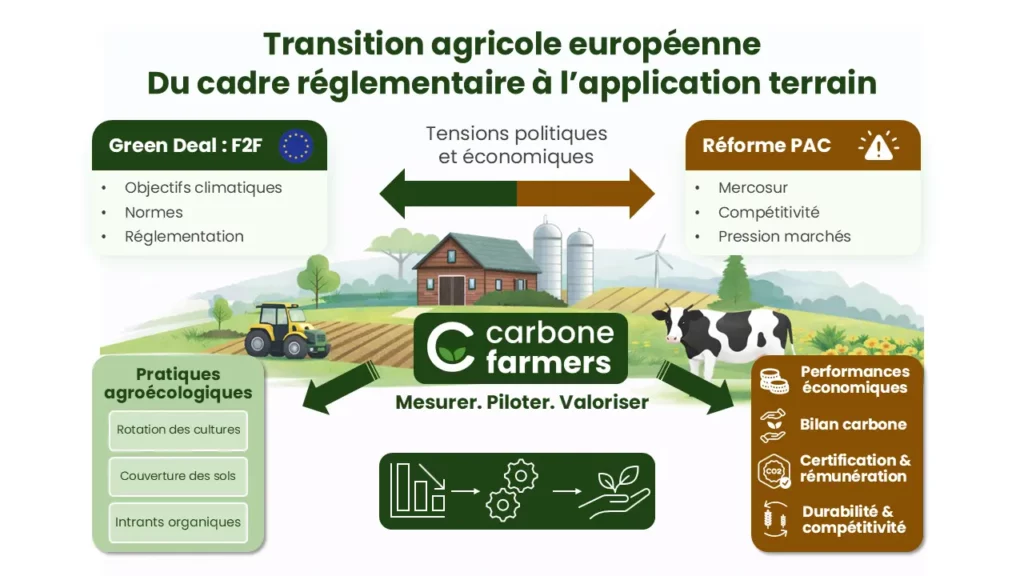
The partial rollback of the «Farm to Fork» strategy is unfortunately not correlated with the disappearance of the climate constraint affecting European agriculture! Instead, it reveals a structural difficulty for the EU in translating environmental objectives into operational trajectories that are acceptable to stakeholders on the ground.
In this context of regulatory volatility, the question is no longer that of the standard, but that of the ability to measure, manage and add value the efforts actually undertaken by agricultural holdings, irrespective of political cycles.
This is precisely where we come in, by bringing measurement and monitoring tools for practices based on field data, certified and compatible with European frameworks. The challenge is not to replace public policy, but to secure credible transition pathways in an uncertain regulatory environment., by giving economic visibility back to committed farmers.
The Commission's «vision for agriculture and food»
In this context, the European Commission published on 19 February 2025, following a Strategic dialogue on the future of EU agriculture, at « Vision for agriculture and food »Presented on the eve of the International Agricultural Show, this communication aims to be more pragmatic than the «Farm to Fork» strategy, by focusing on the simplification of the CAP and the competitiveness of farms.
The Commission also states its intention to reduce distortions of competition, particularly through increased oversight of imports that do not meet European standards. However, this approach remains largely declarative, given the European Union's desire for an open trade policy (for example, the Mercosur case), which limits the effective scope of these announcements.