Agricultural resilience project in Hauts-de-France

The project

Location: Hauts-de-France and Normandy

Surface area: 5284 ha

Engaged Farmers: 37

Methodology: Arable farming

Type: Collective

Monitoring: 2023 – 2027

Total CO2 reductions

37001t

CO₂ icon representing carbon emission reduction

Carbon credits available

37001

Medal icon symbolising recognition and quality

Discounts

12495t

Loop icon representing a continuous cycle

Storage

24506t

Layer icon representing a structure or level

Agricultural resilience project in Hauts-de-France

37001t

CO₂ icon representing carbon emission reduction

Total CO2 reductions

37001

Medal icon symbolising recognition and quality

Carbon credits available

12495t

Target icon representing a goal

Discounts

24506t

Layer icon representing a structure or level

Storage

The project

Location: Hauts-de-France and Normandy

Surface area: 5284 ha

Engaged Farmers: 37

Methodology: Arable farming

Type: Collective

Monitoring: 2023 – 2027

The Project In a few words

Noriap, an agricultural cooperative comprising over 8,200 farmers from Hauts-de-France and Seine-Maritime, is working towards an agricultural model that respects people and ecosystems. In partnership with Carbone Farmers since August 2022, it is measuring the carbon footprint and transition trajectory of 37 farms, thanks to a team of technicians mobilised to collect data and raise awareness among farmers. The latter are showing a strong interest in reducing their environmental impact and increasing carbon sequestration in the soil. Noriap wishes to go further by monetising carbon impact reductions through carbon credits, which will notably finance the introduction of intermediate crops, essential for reducing fertiliser needs. These farmers will become the ambassadors for this initiative in the region. The cooperative also aims to develop markets for low-yield crops, while training its technicians in agroecological practices to support this sustainable transition.

Levers deployed

83 %

Increased interculturalism

65.4 %

Burial of fertilisers

51 %

Introduction to legumes

51 %

Use of steering tools/OAD

41 %

MAFOR

Theirs Testimonial

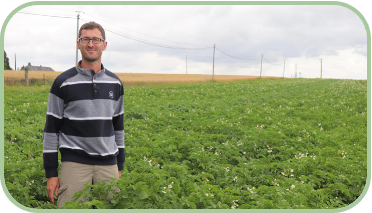
Joining the low-carbon project with Carbone Farmers has allowed me to give my farm a new lease of life. By diversifying my crop rotations and introducing more cover crops, I've improved my soil structure while reducing my inputs. It's motivating to see that my agricultural choices are concretely contributing to reducing the carbon footprint, while ensuring the economic sustainability of my farm.

Guillaume Tesson

Farmer

The Co-benefits of the project

01

Air quality

16%: by reducing the volatilisation of fertilisers and cutting fossil fuel consumption, air quality is improved.

02

Water quality

8 %: impact on water quality through a reduction in nitrate leaching associated with the application of fertiliser to crops.

03

Fossil fuel consumption

Reduction in the consumption of non-renewable energy sources.

04

Water consumption

9%: reducing the impact on water consumption through the diversification of catch crops.

05

Soil quality

18%: reducing the impact on soil quality through the introduction of catch crops that improve soil structure.

06

Biodiversity

Positive impact on the development of soil life and restored balance of flora and fauna.

Contribution du projet aux ODD

The project guarantees French food sovereignty by providing the necessary calories to feed 86,050 people per year.
Through reduced use of synthetic fertilisers, pesticides and fungicides, the project allows for production without risk to the population and farmers.
Reducing synthetic products and improving soil resilience helps reduce nitrate leaching, which pollutes groundwater.
The project offers new outlets for farmers (legumes, flax, chicory, etc.), stimulates the local economy and improves farmers' incomes.
The project offers new opportunities for farmers (legumes, flax, chicory, etc.), stimulates the local economy, and improves farmers' incomes.
The project allows for the stimulation of sustainable industries and responsible production practices for cereals, beetroot, wheat, and textiles.
This is the core of the project, the fight against global warming and the development of carbon sinks. Over its entire duration, the project avoids or sequesters 37,001 tCO2e, which is the equivalent of emissions from approximately 3,700 French people over one year.
This is the heart of the project, the fight against global warming and the development of carbon sinks. Over its entire duration, the project avoids or sequesters 37,001 tCO2e, which is equivalent to the emissions of approximately 3,700 French people over one year.
The project will help preserve terrestrial biodiversity by increasing the input of organic matter into the soil and restoring the biomass of vegetation covers.
The project will help preserve terrestrial biodiversity by reducing the use of plant protection products and promote soil biodiversity by reducing tilling.

Book an appointment with a Carbone Farmers expert

Accelerate your climate strategy by discovering how to invest in local, traceable, and high-impact territorial agroecological projects.

In 20 minutes, we'll analyse your situation, your carbon investment goals and present the most suitable agricultural projects for your organisation.