
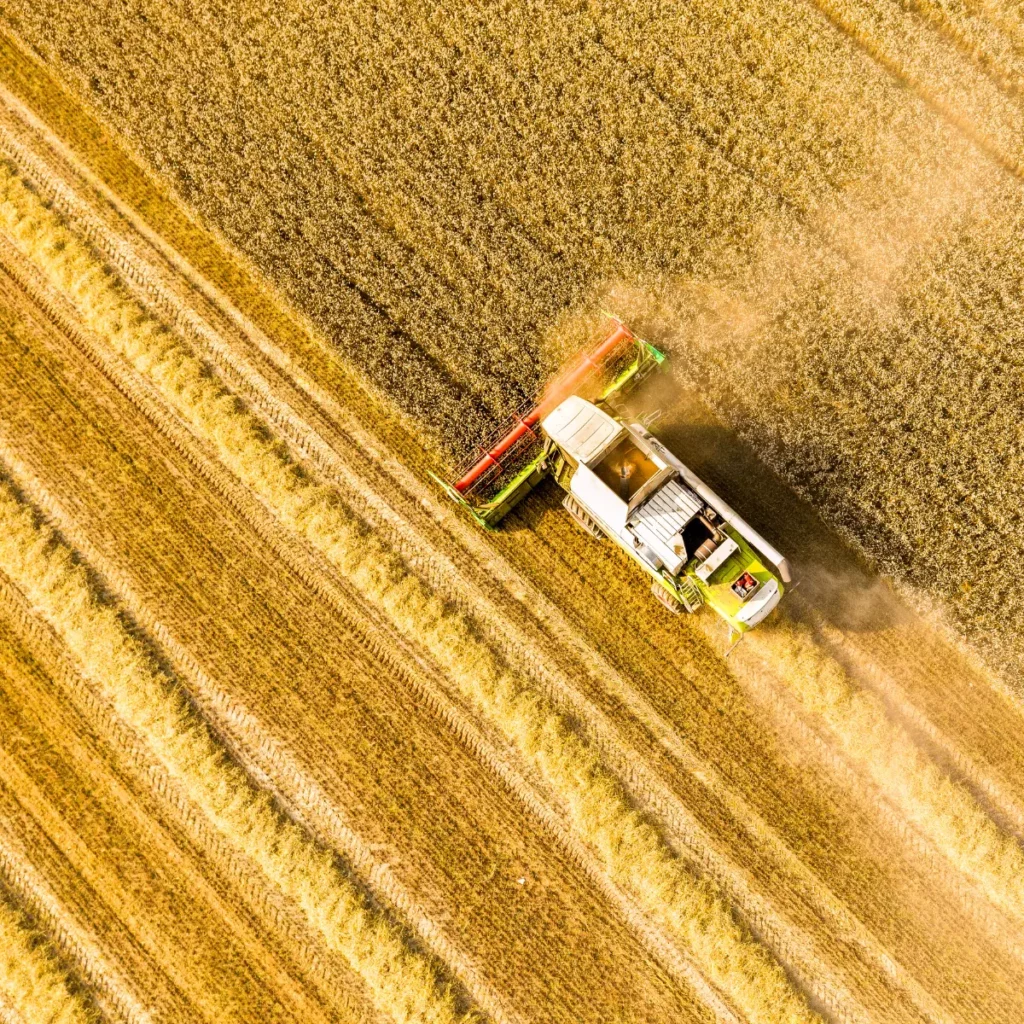
Axereal is a major agricultural and agro-industrial cooperative group, bringing together nearly 11,000 member farmers and over 3,000 employees. A key player in arable farming in France, the cooperative primarily collects and markets cereals and oilseeds, on the French and international markets. Some of these productions are also processed within its own industrial sites, particularly in flour and in Malt.
Through its territorial roots and structuring role, Axéréal is directly concerned by the climate transition challenges facing French agriculture.
In this context, for several years the cooperative has been committed to supporting its members towards agricultural practices that are more sustainable, agronomically effective, and economically viable. This commitment is notably part of the initiative CultivUp Regenerative, which aims to mobilize 3,000 farmers by 2030 around regenerative agriculture practices applied to arable crops.
It is within this dynamic that Axéréal launched its first labelled collective project in 2024 « Label bas carbone certification. » (abbreviated to LBC), in partnership with solution.The objective of this approach is to decarbonise crops collected by the cooperative., by acting at the scale of farm production systems.
This approach aims to measure, certify and value the efforts undertaken by farmers, drawing on low-carbon trajectories that integrate both:
By valuing the practices implemented, The project allows for a better distribution of transition costs, securing farmer commitment over the long term, and integrating the decarbonisation of arable crops into Axéréal's strategy..
Following the launch of its first carbon labelling collective project, Axéréal has, with Carbone Farmers, structured a decarbonisation approach for the arable crops it collects. This approach has been built progressively, to demonstrate the feasibility of a low-carbon transition on the ground, and then extend it to a growing number of farms.
The project is based on a concerted approach with the participating farmers:
The committed farms thus employ several complementary agronomic levers: Nitrogen management, Development of intermediate cutlery, Incorporation of legumes into rotations You Use of organic inputs. These changes in practice aim to improve the carbon footprint at farm level and concern the entire crop rotation.
The process began in Autumn 2023 by a Pilot project bringing together fewer than twenty farms, and focusing mainly on the introduction of legumes such as protein peas into rotations. It was then extended to two new cohorts, in 2025 and 2026, to expand the number of farmers involved, the territories and the areas concerned. Today, Several hundred farms are participating in the Axéréal – Carbone Farmers project, spread over a wide area covering Centre-Val-de-Loire and some adjacent departments.
The rise of Axéréal's project with Carbone Farmers is based on a Methodological and operational framework designed to support farms in the long term and secure the chosen paths.
Beyond measuring carbon impacts, the challenge is to to structure an approach capable of reconciling:
It is from this perspective that Carbone Farmers acts as a trusted third party for agricultural sectors to define models, objectify transition costs, mobilise funding and ensure the continuity of commitments throughout the value chain.
The structuring of a low-carbon approach relies firstly on access to reliable on-the-ground agricultural data traceable. Within the scope of the project, this data comes directly from the farms involved.
The collection covers a set of agronomic and technical data, specifically including inputs, the yields and the cultural practices. These data enable the calculation of’Carbon footprint of farms. They are consolidated at the cohort level in order to more precisely analyse the impacts associated with changes in practices.
Within the framework of our project, this structured data forms the central support for valuing the efforts of male and female farmers. It makes it possible to lay the necessary foundations for construction of tailored economic valuation models.
To exploit and leverage the collected data, Carbone Farmers provides stakeholders with the platform FarmGate Metrics, developed in-house and certified ISO 14067. Designed as a Sectoral management tool, this platform allows to Transform complex agricultural data into directly usable indicators by the actors in the value chain.
FarmGate Metrics Aggregate and structure the data from the farms involved. in order to Calculate commodity-specific emission factors, integrating greenhouse gas emissions and soil carbon sequestration. This allows for To follow the evolution of the carbon footprint of productions collected by Axéréal, from visualiser associated agronomic performance (yields, areas, volumes) and’analyser the breakdown of production by carbon intensity. These indicators offer a detailed view of the trajectories undertaken and facilitate the management of emission reduction efforts.
Beyond environmental monitoring, the platform plays a central role in data valorisation along the downstream value chain. Consolidated results make it possible to establish annual attestations based on the actual performance of farmers, to downstream carbon reporting from companies Axéréal customers, and compatible with repositories GHG Protocol and SBTi FLAG. This traceability strengthens the credibility of commitments and facilitates dialogue between producers, collectors, processors, and distributors.
In the engaged cohorts, Decarbonisation is being tackled at the farm level as a whole. The changes in agricultural practices therefore concern several productions, and not just a single isolated crop.
It is therefore essential to to recognise the efforts made across all the farm's produce. This valuation is based on two complementary levers the payment of premiums, within the framework of low-carbon value chains developed by Axéréal, and the generation of carbon credits as part of the LBC.
The cost of transition towards low-carbon practices can be significant for farms. In this context, a valuation based solely on a premium linked to a single commodity or a single actor may not be enough to cover all the efforts made. The pooling of financing, at the scale of territories and value chains, therefore appears as an essential lever. In the Axéréal x Carbone Farmers project, it was carried out at these two levels:
Finally, carbon credits are coming complete bonus schemes. By adopting an LBC approach, farmers certificate improving their carbon footprint, and thus generating carbon credits, of which they remain the owners, at the scale of their farm. Carbon credits can be purchased by contributing companies during the 5 years of the project or at its end, based on the projected emission reductions. This allows farmers to be supported from the early stages of their commitment, and to financially secure their transition..
solution, as Project manager, supporting the administrative procedures related to the certification and sale of carbon credits, to ensure the fairest possible selling price. Particular attention is paid to Consistency of carbon data usage and at the prevention of any risk of duplicate accounts with the climate commitments of the sectors.
The steps taken by Axéréal and Carbone Farmers have made it possible to laying the foundations for the gradual decarbonisation of large-scale crops, drawing on agroecological practices, robust tracking tools and appropriate appreciation mechanisms. The results obtained across the different cohorts confirm the possibility of reconciling agronomic performance, economic viability, and a real reduction in the carbon footprint..
Following on from its commitments, Axéréal wishes to strengthen the link between its various environmental initiatives and have consolidated management tools at the scale of its supply chains.
The data that has been gathered during this project by our agronomists and the Axéréal teams are dense enough to gradually broaden the performance analysis to include other environmental and agronomic dimensions, such as biodiversity, soil quality, water quality, or farm resilience. The tools we are developing, and in particular the FarmGate Metrics platform, allow for the consideration of reinforced articulation between low-carbon pathways and regenerative agriculture approaches, in line with Axéréal's guidelines.
By taking a long-term approach and engaging an increasing number of farmers, Axéréal and Carbone Farmers' initiative creates new opportunities for low-carbon and regenerative agricultural sectors. It also illustrates the central role of cooperatives in agricultural transition, key players to drive large-scale changes in practice.
Niccolas Rudeaux has been a large-scale crop farmer in the south of Indre for 15 years. He embarked on a low-carbon approach 5 years ago, initially on his own, then with his cooperative, Axéréal.
Nevertheless, Nicolas Rudeaux's path towards sustainable agriculture began some time ago. His father, from whom he took over the farm, had already stopped ploughing in the 1990s. Indeed, their clay soils, which are fragile and hydromorphic, are not well-suited to frequent ploughing. Nicolas Rudeaux continues with no-till farming, and to complement his approach, systematically plants cover crops between his main crops, a practice he discovered through the Axéréal carbon group.
He also appreciates the carbon group's dynamics and is grateful to Axéréal for succeeding in building low-carbon supply chains, which allow him to access premiums to encourage him in his transition.
Today, Nicolas Rudeaux is still keen to train in regenerative practices. He indeed recognises the importance of handing on healthy and productive land, a motivation made all the more significant as his son is showing a keen interest in agriculture...

This website uses cookies to ensure it functions correctly, to measure its audience, and to improve its performance.
You can accept, refuse, or personalise the use of cookies at any time.